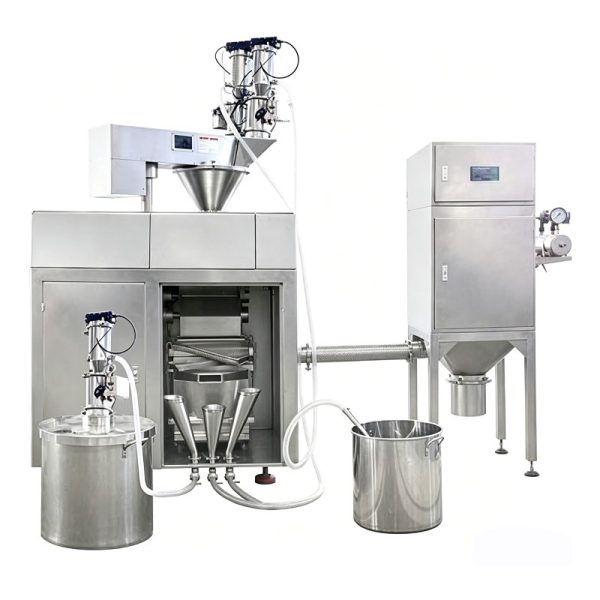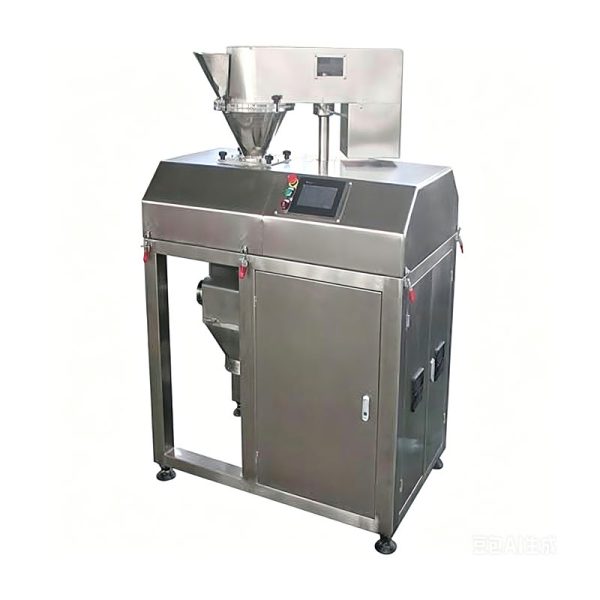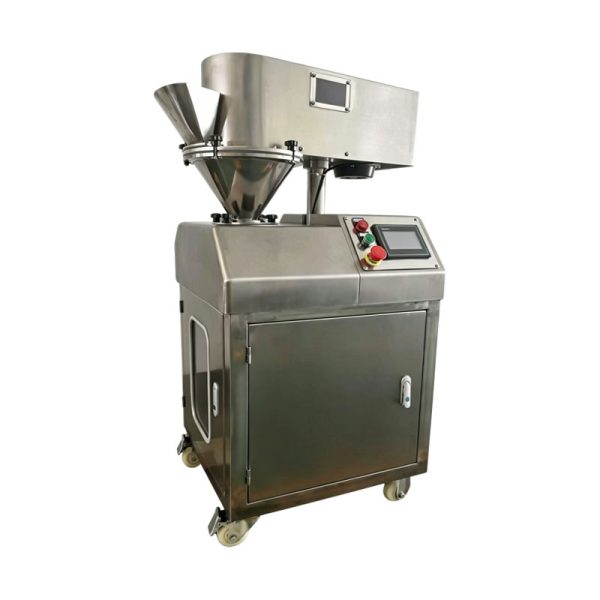


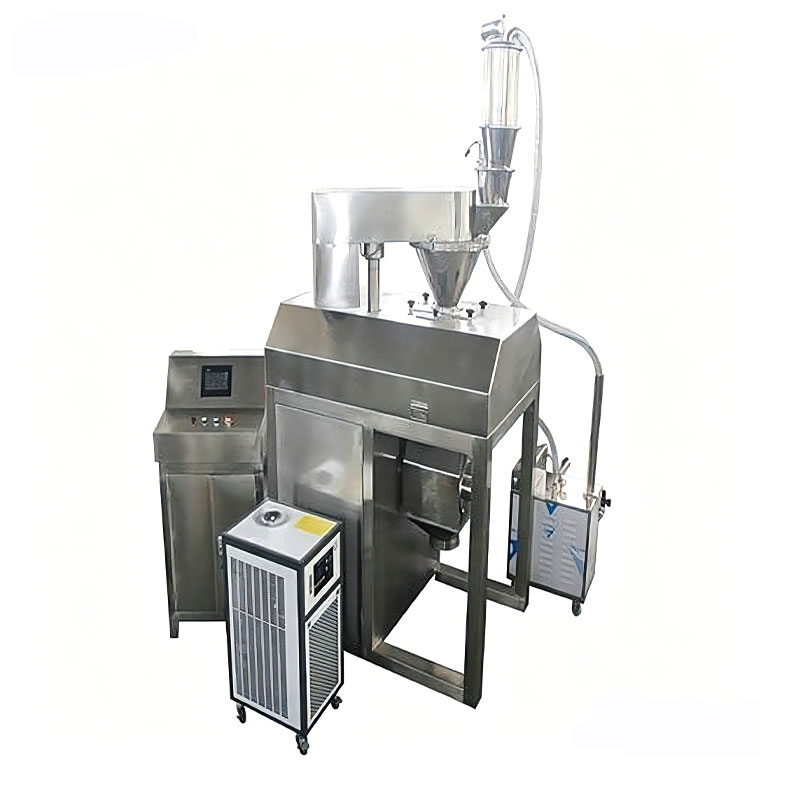
中试型干法制粒机工作原理:
中试型干法制粒机适用于实验室、中间实验装置和小型生产,只需200克左右干粉末就可以其成型性。根据机械挤压造粒工艺原理,将配置好的,具有一定结晶水的干粉状或微细晶体状原料,挤压成薄片,随后经造粒系统,通过筛网制成所需大小的颗粒。原料可通过手工或真空上料机加入料斗,经垂直放置的送料螺杆输送和压缩,被推至两挤压辊轮的咬入角;通过水平放置的压辊,将原料挤压成薄片(压辊的速度决定物料在辊压区停留的时间);物料所需的压力通过液压装置线性传送给压辊,垂直排列的压辊可保证物料密度的一致性。本机装拆、清洗方便。
The screen mesh size in the granulation system of a device can be interchanged according to different particle size requirements. The powder raw material is directly made into granular products that meet user requirements without any intermediates or additives. The granulated product has uniform particle size, significantly increased bulk density, and improved flowability. This controls dust emissions, reduces powder waste, and facilitates storage and transportation. It can also control solubility, porosity, and specific surface area. It can be directly used for tableting or capsule filling.
For the granulation of drugs that are unstable under wet and hot conditions and cannot be granulated by traditional wet granulation. Dry granulation processes can replace the continuous line input of wet granulation, saving manpower, material, and financial resources, and are energy-saving and environmentally friendly equipment.
中试型干法制粒机的优点:
This machine is composed of feeding, tablet pressing, hydraulic, frame, and electrical control components. Feeding, tablet pressing, and granulating all use stepless speed regulation via frequency conversion. The oil pump pressure is adjustable, and the fineness of the finished product can be obtained by replacing different screens. The improved granulating cage increases the yield of particles. The machine is easy to assemble and disassemble for cleaning, and all parts that come into contact with the material are made of stainless steel. The product meets GMP requirements. Material is added through the top feeding hopper, is then forcibly extruded into flakes by two pressing rollers, and enters the lower granulating chamber. In the granulating chamber, the flaked material is broken up by granulating blades and then enters the pelletizing chamber until the particles are less than or equal to the mesh size. The particles then pass through the screen into the material receiving tray. The desired particle size can be determined by adjusting the screen size.
中试型干法制粒机应用范围:
For dry powder granulation needs in industries such as food, pharmaceutical, pesticide, and chemical.
Pharmaceutical Industry - Granules for pharmaceutical preparation, Granules for traditional Chinese medicine formulas, Granules for antibiotic capsule filling, Granules for direct antibiotic administration, Granules for veterinary medicine, Powders for dialysis preparations;
Food industry - Granules for seasonings and spicy seasonings, granules for snack production, granules for health food, convenience food, seasonings, dairy products, and ** granules
Chemical industry and others—cosmetics, pesticides, chemical drugs, animal feed, detergents.
Particles for the electrical industry, mechanical industry, such as ferrite blocks, talc, porcelain materials, oil-impregnated bearings, electromagnetic materials, and other metallurgical applications.
Granules of various plastics for molding in the plastics industry, such as phenol, urea, melamine, and epoxy resin.
Granules for catalysts in the chemical and other industries, fertilizers, feed, pigments, cosmetics, flour milling, and various chemical cleaning agents.
中试型干法制粒机新结构简介:
Machine Design: Water cooling system (can be configured individually based on material heat load), electrical monitoring system, reasonable structure, stable and reliable performance, no tetrafluoroethylene powder or metal substances in particles, exquisite manufacturing, uses German production technology, equipped with an automatic feeding system, convenient for disassembly, cleaning, and maintenance, meets GMP requirements.
The machine is composed of lifting, feeding, tablet pressing, granulating, hydraulic, frame, outer casing, and electrical components.
The lifting and lowering part uses a hydraulic lifting cylinder to achieve the rising and lowering of the feeding mechanism. Limit switches control the position and are interlocked with the feeding, pressing, and pelleting mechanisms.
The feeding section is driven by a motor to rotate a screw with a double-cone and unequal pitch, which pre-compresses and degasses the powder. The feeding speed can be infinitely adjusted (variable frequency speed control) according to the properties of different materials.
The tablet press is driven by a cyclo-gear motor, which rotates the drive shaft. This, in turn, drives the two pressing rollers to rotate relative to each other. The combined action of rotation and pressure compresses the powder into tablets. The roller speed can be steplessly adjusted (via variable frequency drive) based on the compressibility of different materials.
The pelletizing section is driven by a variable frequency motor, which rotates the pelletizing knives to form flaky materials into the desired granules, which are then discharged through the mesh.